
5 Engineering Principles That Separate Systems That Scale From Systems That Fail

A practical playbook for building software that scales without breaking.
Engineering platforms tend to follow one of two trajectories: maintainable and change-tolerant, or brittle and risk-prone. The first enables steady delivery and contained incidents; the second turns routine changes into high-stakes releases and accelerates technical debt.
The differentiator is rarely technology choice. It’s a handful of foundational principles—applied early or paid for later—that consistently separate scalable systems from failing ones.
This article breaks down five. Regardless of whether you’re architecting a platform, managing delivery, or early in your career, these principles will sharpen your design instincts and your understanding of cost over time.
Summary
- First Principles Thinking — Start from goals and facts, not templates. The simplest system that meets the requirements is almost always the right one.
- SOLID Principles — Five design guidelines that keep codebases flexible, testable, and safe to change as they grow.
- Separation of Concerns vs. SRP — SoC defines where things live in your system. SRP defines how focused each unit is inside those boundaries. You need both.
- DRY vs. WET — Centralize stable, universal knowledge. Keep volatile, context-specific behavior local — even if that means intentional duplication.
- Coupling and Cohesion — Low coupling between modules and high cohesion within them is the foundation of every design worth maintaining.
1. First Principles Thinking: Stop Borrowing Answers to Questions You Haven't Asked
Engineers accumulate patterns the way consultants accumulate frameworks. This is largely useful — until it isn't. When a team reaches for a familiar solution before fully understanding the problem, they introduce accidental complexity: cost, moving parts, and failure modes the problem never demanded.
First principles thinking is the antidote. Strip a problem to its verifiable facts — the outcome required, what cannot break, how the workload behaves, what it costs at scale — and only then select tools and architecture. Instead of asking "what did we use last time?" ask "what is the simplest system that meets this specific goal?"
The practical loop:
- Set a measurable goal (response time, uptime, cost per thousand requests) and rank priorities so conflicts surface early
- Write down hard constraints: compliance, data residency, RTO/RPO, team skill limits
- Measure the actual workload using logs and scripts — never guess
- Think in abstract building blocks (queue, cache, time-series store) before mapping to brand names
- Sketch the smallest system that meets the facts, with clear failure paths and backpressure
- Put a price next to every arrow at 1×, 10×, and 100× scale
- Test with real payloads and controlled chaos
- Record the decision in a one-page Architecture Decision Record (ADR)
When teams skip it: A team copied a Kafka → stream database → full-text search template for device telemetry. They never checked what the dashboards actually needed. The answer was coarse, time-bucketed metrics — no free-text search at all. The search index consumed six times more storage than necessary, reindexing slowed ingestion, and egress costs ballooned. A first-principles review would have produced a simpler, cheaper, more reliable design from day one.
For leaders, the takeaway is direct: expensive architectural failures almost always start as unchallenged assumptions. Teams that practice first principles produce systems with better unit economics, clearer trade-offs, and faster onboarding — because the reasoning is captured alongside the diagram.

2. The SOLID Principles: Guardrails Against Entropy
As systems grow, complexity is inevitable. Chaos is optional. The SOLID principles — five design guidelines introduced by Robert C. Martin — exist to keep codebases flexible, testable, and maintainable as requirements evolve. Think of them less as rules and more as a compass that prevents engineering from drifting into unmanageable territory.
The five principles, unpacked:
- Single Responsibility (SRP) — A class has one reason to change. Prevents "God classes" that become impossible to safely modify.
- Open/Closed (OCP) — Open for extension, closed for modification. New behavior is added by extending, not by editing working code.
- Liskov Substitution (LSP) — Subclasses must honor the contract of their parent. Polymorphism should never produce silent surprises.
- Interface Segregation (ISP) — Keep contracts lean. Components should not depend on methods they will never use.
- Dependency Inversion (DIP) — Depend on abstractions, not concretions. Decouples high-level policy from low-level implementation details.
Together, these principles describe a codebase where components can be composed, replaced, or extended without risk of collapse elsewhere.
What ignoring them looks like: One payments platform hard-coded third-party gateway references into its core processing logic. When the business expanded to new markets, developers had to rewrite classes that processed real payments. Each edit introduced regression risk. A simple extension became weeks of firefighting — timelines slipped, customers noticed, and engineers lost confidence in their own system. A properly abstracted gateway interface would have made each new gateway an additive change, not a structural overhaul.
SOLID is not perfectionism. It is the discipline of reducing the cost of change over the lifetime of a system — a cost eventually paid by engineers, product teams, and the business alike.

3. Separation of Concerns vs. Single Responsibility: Two Lenses, One Goal
These two principles are often used interchangeably. They should not be — they operate at different levels of zoom, and conflating them creates blind spots in both architecture and module design.
Separation of Concerns (SoC) is an architectural idea. Divide your system into slices that each address one distinct concern. Vertical boundaries might be Order, Payment, and Inventory. Horizontal layers might be Presentation, Application, Domain, and Infrastructure. Good separation produces clean interfaces — REST, gRPC, events — so each part evolves independently. Cross-cutting concerns like auth, logging, and metrics belong in middleware, not scattered through domain logic.
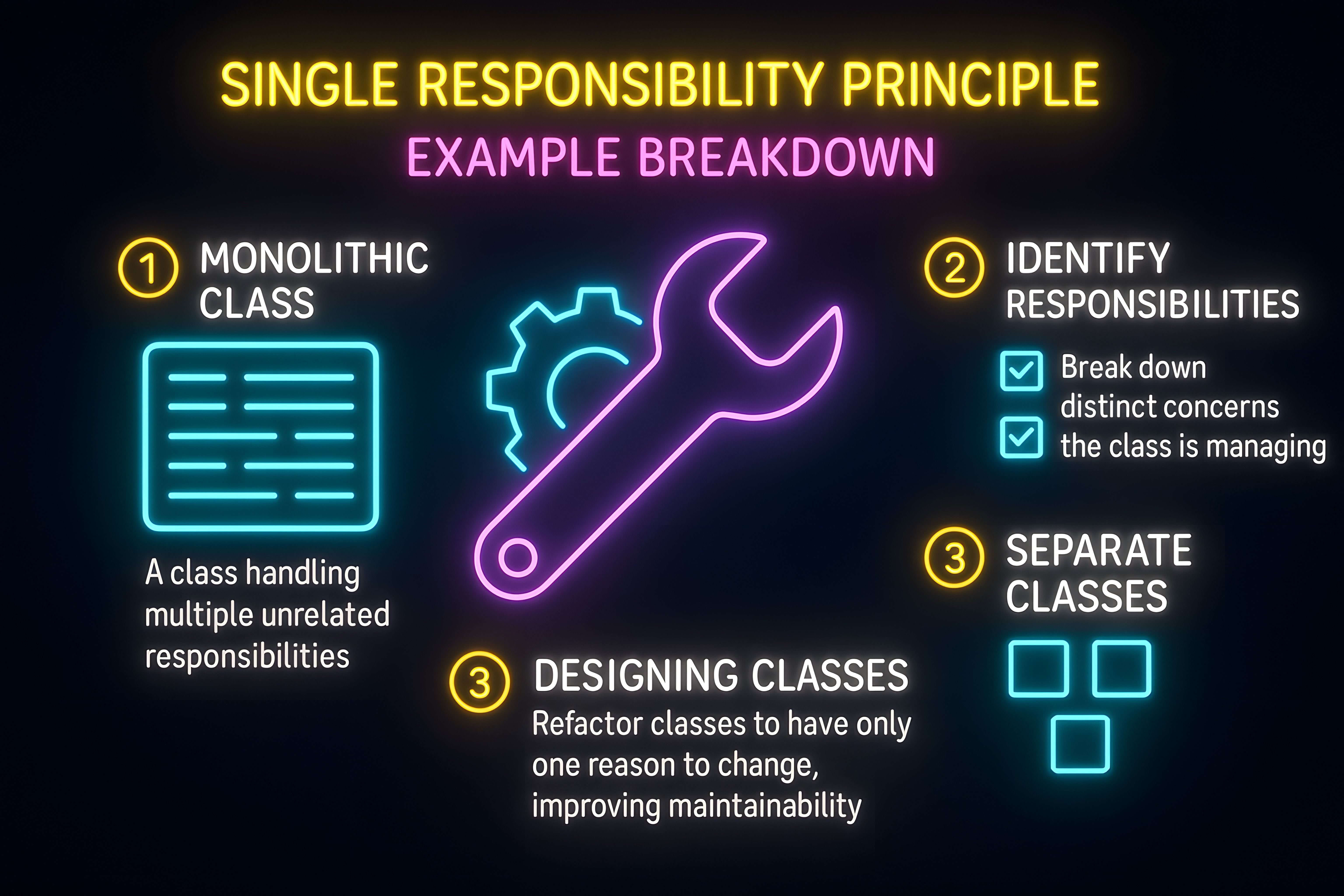
Single Responsibility Principle (SRP) works inside those boundaries. Each unit — class, module, function — should have one reason to change. A PriceCalculator changes when the pricing policy changes. It should not change when the database schema or logging format changes.
How they fit together:
- SoC tells you where things live in the system
- SRP tells you how focused each unit is inside those boundaries
- Good SoC with poor SRP produces well-named services with tangled internals
- Good SRP with poor SoC produces cohesive modules in the wrong places
The cost of mixing them: A retail team's single "OrderService" handled HTTP transport, validation, authorization, discount calculation, inventory checks, payment capture, database writes, and audit logging — all in one place. A minor change to discount rounding required simultaneous edits across DTOs, calculation logic, and persistence code. A payment retry hotfix inadvertently bypassed inventory reservations. After splitting the service into a lean orchestrator, focused domain services, and clean adapters, a rounding policy change touched one module and one test suite.
Code smell checklist: files that import everything, methods containing both business rules and retry logic, classes that understand HTTP, SQL, and JSON simultaneously. These are the fingerprints of entangled concerns.
4. DRY vs. WET: The Abstraction Judgement Call
Every engineer has watched the pendulum swing between two failure modes: copy-pasting code to ship fast, or building a grand unified abstraction that everything depends on. Both are expensive. The craft lies in knowing which applies, when, and at which level.
DRY — Don't Repeat Yourself — means each piece of knowledge has one authoritative home. This is broader than avoiding copy-paste. It covers business rules, schemas, error codes, event contracts, and infrastructure modules. Target DRY at things that are stable and universal.
WET — Write Everything Twice — is intentional duplication to preserve independence. Choose WET when behavior diverges by bounded context, requirements are volatile, or similar-looking code hides different invariants. WET limits coupling and keeps change local.
Practical heuristics:
- Rule of Three — Tolerate duplication until the third repetition. Before that, you are likely abstracting a coincidence.
- Stability first — Centralize only what has been stable for two or more release cycles. Volatile rules belong close to the team, changing them.
- DRY within a context, WET across contexts — Cross-boundary sharing creates a coordination tax unless contracts truly align.
- Generate, don't hand-abstract — Use IDL-generated clients (OpenAPI, Protobuf) to stay DRY on contracts while keeping services WET on behavior.
When the wrong abstraction breaks everything: A team extracted a "UniversalEventNormalizer" library across eight services. When Payments introduced multi-capture semantics, the library needed breaking changes. The result: eight coordinated releases, one lagging service, mis-parsed events, broken KPIs, and an incident. The post-mortem found the library had mixed stable contract parsing with volatile domain mapping. The fix was simple — keep IDL-generated parsers shared (DRY), move per-service mappers local (WET). The next change touched one service, needed no coordination, and caused no outage.
DRY reduces entropy. WET preserves autonomy. The skill is knowing which matters more in each situation.

5. Coupling and Cohesion: The Heart of Every Design Decision
Experienced engineers eventually arrive at a quiet realisation: elegant design is not about frameworks or clever abstractions. It is about how well components relate to each other. Coupling and cohesion determine whether a system scales gracefully or collapses under change.
Coupling measures how dependent one module is on another. Not all coupling is equal:
- Content coupling — One module reads or modifies another's internal data. The worst case.
- Common coupling — Modules share global state. Risky and opaque.
- Control coupling — A module dictates another's execution path. Often a design smell.
- Data coupling — Modules share only the data needed. Acceptable.
- Message coupling — Interaction through well-defined contracts. Best for distributed systems.
Cohesion measures how closely the responsibilities within a module relate. High cohesion means a component does one thing well. Low cohesion produces "God classes" — modules handling workflows, validation, formatting, persistence, and side effects all at once. They are hard to name, hard to test, and dangerous to change.
Why this balance matters:
- Low coupling enables independent deployment, testing, and scaling of each component
- High cohesion reduces cognitive load and makes onboarding faster
- Together they shrink the blast radius of failures and prevent cascading incidents
The cost of getting it wrong: One team built an "Order Processor" that handled validation, pricing, inventory, payment routing, and notifications in a single service — while directly querying internal tables from two other systems. Every small change broke multiple flows. Regression cycles grew longer. When the business needed real-time scalability, the architecture was too coupled and too incoherent to evolve without a full rewrite. A costly, entirely avoidable reset.
Coupling and cohesion are not academic ideals. They are the signals that tell you how future-friendly your design actually is.

The Common Thread
These five principles are not independent checklists — they reinforce each other. First principles thinking produces designs worth applying SOLID to. SOLID gives modules the focused purpose that Separation of Concerns requires. DRY and WET judgements are sharper when coupling and cohesion are well understood. And coupling and cohesion inform where concerns should be separated in the first place.
The common thread is intentionality: understanding why a design choice is made, not just what was chosen. Systems built on that foundation are cheaper to operate, faster to change, and easier to hand off. The ones that ignore it become the cautionary tales told in post-mortems and onboarding sessions.
Pick one principle. Apply it to one service this week. Measure PR size before and after. The results tend to be convincing.
The Short Answers
What are the SOLID principles, and do I need to apply all five at once? SOLID is a set of five object-oriented design guidelines: Single Responsibility, Open/Closed, Liskov Substitution, Interface Segregation, and Dependency Inversion. You do not need to apply all five simultaneously. Most teams find SRP and DIP offer the fastest return. Start there — the others compound the benefit over time.
What is the difference between coupling and cohesion? Coupling measures dependency between modules — how much one module needs to know about another. Cohesion measures the relatedness of responsibilities within a single module — how focused it is. The goal is low coupling between components and high cohesion within them. Systems that achieve this are easier to test, deploy independently, and scale without cascading failures.
What is the difference between Separation of Concerns and Single Responsibility? They address the same goal at different levels. Separation of Concerns (SoC) is architectural: divide the system into distinct slices — API, domain, persistence, UI — so each evolves independently. Single Responsibility (SRP) is module-level: each class or function should have one reason to change. SoC tells you where things belong; SRP tells you how focused each unit inside those boundaries should be.
When should I use DRY and when should I use WET? DRY suits stable, universal knowledge: event contracts, error codes, auth policies, infrastructure modules. WET — intentional duplication — suits logic that is context-specific, volatile, or owned by different teams. A reliable heuristic: tolerate duplication until the third occurrence (the Rule of Three), then evaluate whether an abstraction is genuinely warranted. If the shared code would require coordinated releases across teams to change, it is likely the wrong abstraction.
What is First Principles Thinking in a software engineering context? It means starting every design decision from the facts of the problem — measurable goals, hard constraints, actual workload behaviour, and cost at scale — rather than from inherited patterns or industry defaults. Instead of asking "what is the standard approach?" ask "what is the smallest system that provably meets these requirements?" The output is a documented decision (an Architecture Decision Record) that ties every choice to a number or a constraint, not a habit.
How do these principles apply outside of backend engineering? Very directly. Frontend teams apply Separation of Concerns by splitting state, UI, and API logic. Infrastructure-as-Code teams use DRY through reusable Terraform modules and WET when environment-specific logic diverges. Data engineering teams use first principles to avoid over-engineered pipelines. For C-suite and product leaders, understanding coupling and cohesion helps evaluate whether a platform can absorb a new product requirement without a costly rewrite — because architectural decisions ultimately drive delivery speed and operational cost.


Enterprise UX in Digital Transformation: Lower Risk and Increase Adoption