
How Design Thinking Improves SAP, Portal, and Self-Service Adoption

A well-built system can still fail if it solves the wrong problem. Most projects deliver the system that was specified, not the solution that was truly needed.
Procurement portals go live but fail to gain traction. SAP Fiori rollouts create helpdesk demand instead of productivity gains. Self-service platforms are bypassed in favour of phone calls and manual support. The technology may function, but users still do not trust it. In most cases, that happens because teams never fully understood user needs before the build began.
This is where design thinking matters. It is a practical, user-centred approach to problem-solving that helps teams understand real needs before they commit to workflows, features, and architecture. It is not a creative luxury. It is a risk-reduction discipline that helps enterprises avoid building the wrong solution.
At Tarento, this is how LEAD sprints are run: understand the user journey, map pain points, turn insights into focused “How Might We” questions, prototype early, and measure adoption after launch. The result is not just better interfaces, but better enterprise outcomes.
if you want transformation programmes to stick, do not begin with features or architecture. Begin with the user.
Why Human-Centred Design Matters in Enterprise Transformation
Enterprise digital initiatives carry a structural challenge that consumer products often do not: the people approving the system are rarely the people using it every day.
A compliance manager and a field technician may both interact with the same SAP workflow, but in very different ways. A citizen using a government portal has a very different mental model from the public-sector team that commissioned it. When teams do not examine this gap, they build around internal assumptions. After launch, they then spend time and budget on training, support, workarounds, and change management to fix the mismatch.
Design thinking addresses this problem directly. It starts with user evidence. It creates outputs based on observed behaviour, not stakeholder opinion. It also tests assumptions before they harden into expensive architecture and delivery decisions. Just as important, it creates organisational alignment. A shared understanding of the user gives business and IT teams a shared language, reducing the friction that often derails enterprise transformation. It also creates organisational alignment. A shared understanding of the user gives business and IT teams a common language, helping them align faster and focus on what matters most.
The 6-Phase Design Thinking Framework for Enterprise Transformation
Design thinking moves through three broad motions — Understand, Explore, and Materialize — expressed in six practical phases. In enterprise transformation, each phase reduces a different kind of delivery risk. Together, they help teams move from assumption to evidence, from opinion to alignment, and from concept to adoption-ready execution.
Empathize — Conduct qualitative research to understand what users do, say, think, and feel. In enterprise programmes, this means speaking with the procurement coordinator, the field auditor, and the service-desk agent, not just the project sponsor. The goal is to gather enough evidence to understand what truly helps or blocks users in their daily work.
Define — Turn research into clear, prioritised problem statements. Where do the same friction points appear across different users? What unmet needs sit beneath the stated requirements? This phase creates the design brief that guides the project, and that brief should be based on evidence, not assumption.
Ideate — Explore a wide range of possible solutions before narrowing the options too early. At this stage, breadth matters. The wider the exploration, the lower the risk of locking into the first reasonable-looking answer.
Prototype — Create lightweight, testable versions of the strongest ideas. In enterprise settings, this may mean sketches, wireframes, or click-through prototypes created before development begins. The goal is to keep learning inexpensively while the cost of change is still low.
Test — Put the solution in front of real users. Does it actually work for them? Does it reduce friction? Does it improve confidence, speed, or clarity? Testing before full implementation is one of the most cost-effective forms of quality assurance available in enterprise transformation.
Implement — Deliver the solution fully and make sure it reaches the people it was designed for. Design thinking creates value only when its outputs are fully implemented and reach the people they were designed for.
One of the most valuable qualities of design thinking is that it scales well. The same framework that improves a single form flow can also help reshape a large citizen-service platform or enterprise self-service ecosystem.
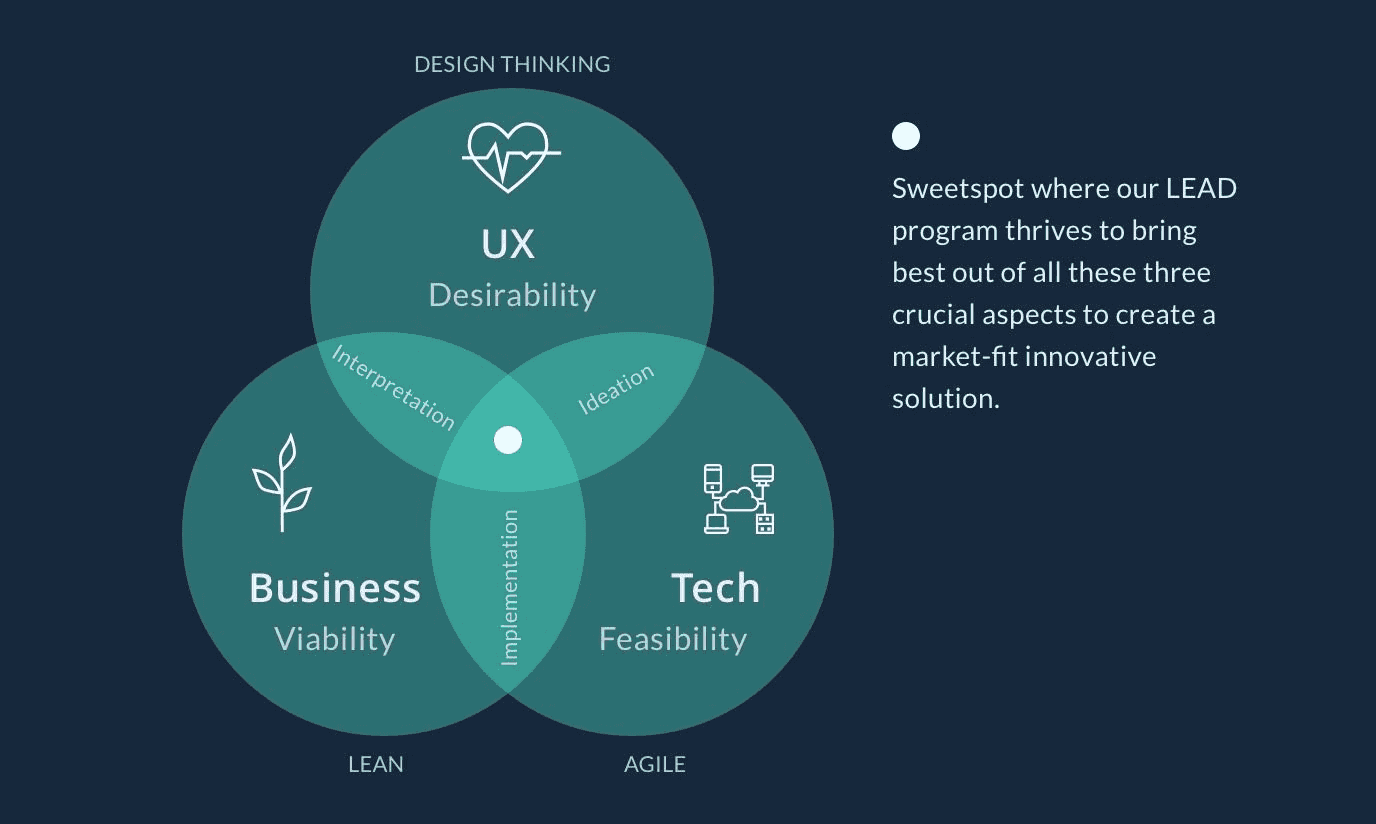
How Tarento Applies Design Thinking in Enterprise LEAD Sprints
1. Scope the human problem, not the technical brief. Before discussing architecture, Tarento defines which user and which journey is under review, for example, “an accounts payable officer completing a three-way match in SAP Fiori.”
2. Run structured empathy research. We combine interviews, contextual observation, analytics, and support-ticket analysis to build a rounded picture of the user. This research is direct and qualitative because observed behaviour often reveals friction that survey summaries miss.
3. Build and validate Empathy Maps. Research findings are synthesised into empathy maps so that developers, product owners, and business leads all share the same understanding of the user they are designing for.
4. Frame the design challenge with How Might We questions. Instead of jumping straight from research to solution, Tarento runs structured HMW sessions that keep ideation focused on root causes rather than surface symptoms.
5. Prototype and test before building. Low-fidelity wireframes are tested with five to eight representative users per round. Structural issues are identified and corrected before the development effort is committed.
6. Implement with adoption metrics built in. After go-live, we track task completion, monitor error rates, and run iteration cycles, because design thinking does not stop at launch.
Empathy Mapping and How Might We Questions for Enterprise Workshops
Empathy Mapping is the bridge between raw research and shared team understanding. It is a collaborative way to capture what a team knows about a specific type of user. In practice, it helps teams externalise user knowledge, create shared understanding, and make better decisions.
A well-built empathy map organises insights across four quadrants — Says, Thinks, Does, and Feels — with the user at the centre. In enterprise programmes, where teams often operate in silos, the empathy map becomes a single source of truth. It prevents different departments from carrying different assumptions about the same user into the build.
Critical enterprise practices:
- One map per persona. A BFSI portal serving compliance officers and branch managers should use separate maps. Combining personas usually produces designs that satisfy neither group well.
- Fill quadrants independently first. Anonymous sticky-note input before group discussion helps prevent the most vocal stakeholder from shaping the team’s view of the user too early.
- A sparse quadrant signals a research gap. If the Thinks or Feels quadrant is mostly empty, more qualitative research is needed. Do not move forward on assumption.
How Might We (HMW) questions convert empathy insights into focused ideation. The method helps teams avoid jumping too quickly to predetermined solutions by framing challenges as open invitations to explore. In Tarento LEAD workshops, we use five discipline rules to keep HMW questions useful and actionable:
- Ground every HMW in a specific research finding, not a broad aspiration.
- Avoid embedding solutions. “How might we make users feel confident in the approval process?” is stronger than “How might we add a status tracker to approvals?”
- Frame positively. “How might we make document submission quick and intuitive?” opens up more useful options than “How might we reduce submission errors?”
- Keep the question broad enough for exploration, but specific enough to stay anchored to a real user problem.
- Prioritise HMWs by impact. In enterprise settings, ideation should focus first on friction points with the biggest effect on adoption, trust, and productivity.

Start with User Needs Before You Scale the Solution
Design thinking is not just for product studios. In enterprise transformation, it helps determine whether a system gets adopted or avoided.
When organisations start with empathy, define the right problem, and test before they build, they reduce the risk of scaling the wrong solution. The real advantage goes to enterprises that treat human understanding as the starting point, not the final polish.
FAQ: Design Thinking for SAP, Portals, and Self-Service Platforms
- What is design thinking in enterprise transformation?
Design thinking in enterprise transformation is a structured, user-centred approach to solving business and technology problems. It helps organisations understand real user needs before building SAP workflows, portals, or self-service platforms, reducing the risk of low adoption and costly rework.
- Why is design thinking important for SAP, portals, and self-service platforms?
These systems often fail not because the technology is weak, but because the user experience does not match how people actually work. Design thinking helps teams uncover friction early, align business and IT stakeholders, and improve adoption after go-live.
- How does empathy mapping help enterprise teams?
Empathy mapping turns research into a shared view of the user. It helps cross-functional teams understand what users say, think, do, and feel, so developers, business leaders, and UX teams are solving the same problem from the start.
- What are How Might We questions used for?
How Might We questions help teams turn user insights into focused ideation. Instead of jumping to solutions too early, they frame the challenge in a way that encourages better options and keeps workshops anchored to real user problems.
- How does Tarento use design thinking in LEAD workshops?
Tarento applies design thinking through structured LEAD sprints that include empathy research, problem framing, empathy mapping, HMW workshops, low-fidelity prototyping, and early testing. This helps enterprise teams validate the right solution before committing to full-scale delivery.
- Can design thinking improve enterprise adoption metrics?
Yes. When applied well, design thinking can improve adoption, reduce abandonment, lower support-ticket volumes, and decrease training overhead. It works by aligning the system design to real user mental models before launch.
- When should enterprises use design thinking?
The best time is at the start of any transformation initiative, especially for SAP modernisation, employee or citizen portals, workflow redesign, and self-service platforms. It is most effective before architecture and feature decisions become expensive to reverse.
- Is design thinking only relevant for UX teams?
No. In enterprise settings, design thinking is most effective when used across business, IT, delivery, and UX teams together. It improves decision-making, reduces internal friction, and creates shared ownership of the user problem.
Book a Tarento LEAD Discovery workshop to embed design thinking into your next enterprise initiative


Designing for Intelligence: The Real Foundations of AI-ready Platforms