

23 February 2026
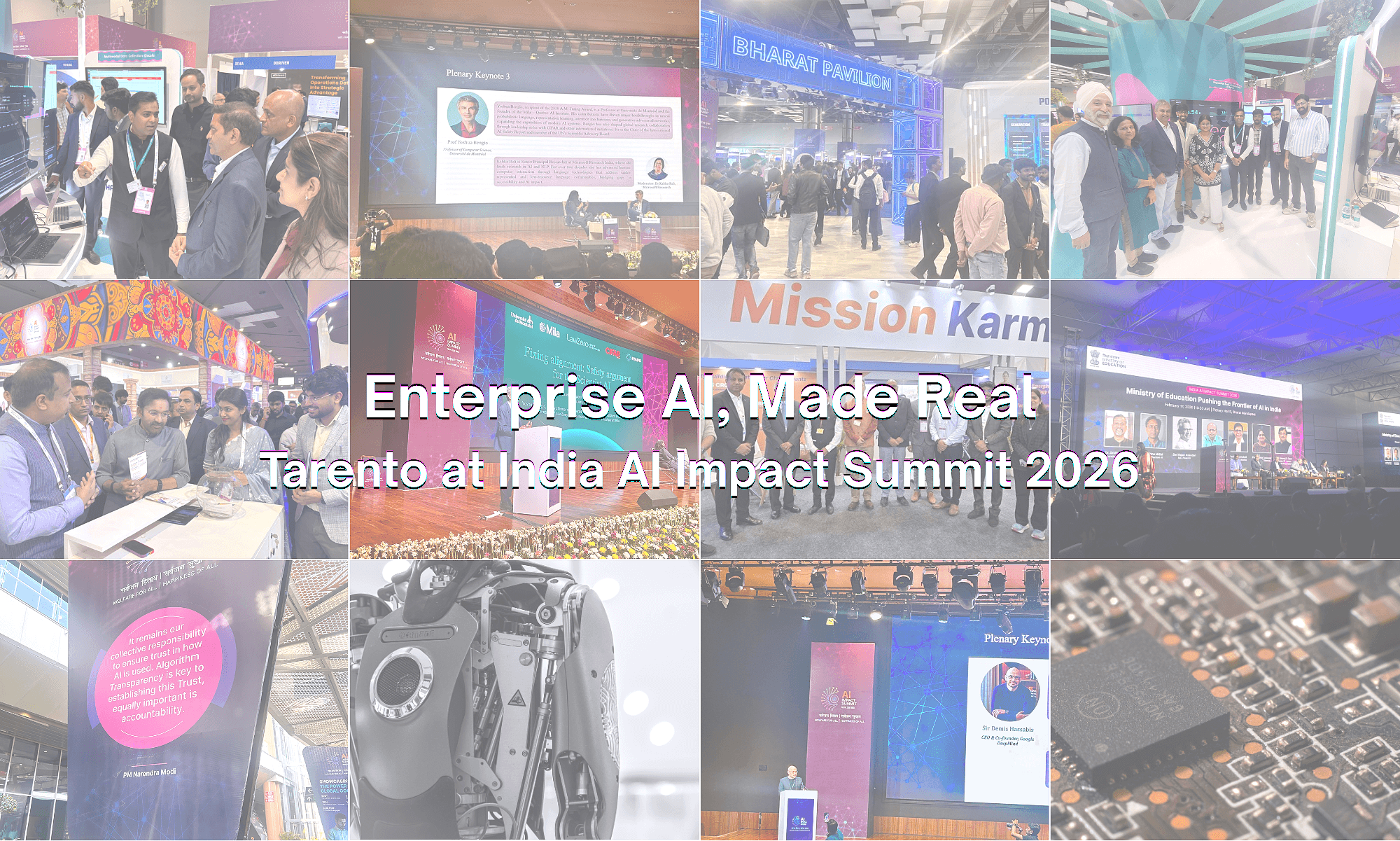
Tarento joined global leaders, policymakers, and technology innovators at India’s AI Impact Summit 2026 at Bharat Mandapam, New Delhi (16–20 February 2026), a major milestone in the global AI conversation.
With delegations from over 100 countries and a diverse range of ecosystem partners, the summit marked a shift: the global AI dialogue is moving beyond hype to real-world deployment, governance, and measurable outcomes.
For Tarento, participating in this forum aligned with a clear focus: helping organizations embed AI into enterprise systems in ways that create business value, operational impact, and long-term resilience.
From AI Vision to Execution
What stood out most at the summit was the quality of the conversations.
This was not a forum centered only on futuristic AI possibilities. It brought together policymakers, enterprise leaders, architects, and civil society to address a more urgent question:
How do we deploy AI responsibly and at scale?
Across industries, organizations have advanced from AI pilots to decision-making that demands strong data, governance, and clear ROI. The summit reflected this evolution.
A Values-Led Framework for AI Adoption
One of the summit’s key outcomes was the New Delhi Declaration on AI Impact, endorsed by 89 countries and international organizations.
The declaration was anchored in the Sanskrit principle:
“Sarvajan Hitaya, Sarvajan Sukhaya” — for the welfare and happiness of all.
This principle shaped the summit’s organizing philosophy through the Three Sutras:
- People – AI must serve humanity with dignity, fairness, and inclusion.
- Planet – AI innovation must align with sustainability and environmental responsibility.
- Progress – AI’s benefits must be shared equitably to support global development.
The Seven Chakras Framework: A Practical Cooperation Agenda
Building on the Three Sutras, the summit introduced the Seven Chakras Framework, outlining priority areas for global AI cooperation.
These include:
- Democratizing access to AI resources
- Building trusted and secure AI systems
- Advancing AI for scientific discovery
- Driving social empowerment through AI
- Developing human capital at scale
- Strengthening resilient and efficient AI infrastructure
For enterprises, this matters because the same themes often appear within organizations: access, trust, skills, security, and infrastructure readiness are frequently the real constraints to scaling AI.
India’s Human-Centric AI Governance Message
Prime Minister Narendra Modi’s address reinforced a central idea: AI should work with humans, not replace them.
He introduced the M.A.N.A.V. framework, emphasizing:
- Moral and Ethical AI
- Accountable Governance
- National Sovereignty
- Accessible and Inclusive Systems
- Valid and Legitimate Outputs
This framing places equal weight on innovation and accountability. It also highlighted practical safeguards such as authenticity labels and watermarking, especially in the context of deepfakes and misinformation.
On jobs and workforce transformation, the message was equally pragmatic: AI adoption must be paired with skilling, reskilling, and lifelong learning. This resonated strongly with enterprise leaders working through the operational realities of AI transformation.
The Real Enterprise Challenge: From Pilots to Production
A recurring theme across summit discussions was one that many technology leaders already know well:
AI success is not defined by a pilot. It is defined by production outcomes.
The hardest problems are rarely model-related alone. The real barriers typically include:
- fragmented data environments
- weak governance mechanisms
- integration complexity
- unclear ownership across teams
- change management challenges
- gaps in workforce readiness
Tarento’s engagements at the summit reflected this reality. Conversations with ecosystem partners and industry collaborators centered on practical execution questions — not just what AI can do, but what it takes for organizations to absorb AI into core workflows responsibly and sustainably.
Innovation on Display: The Expo Layer
The summit also included a major expo component, with the official site highlighting 300+ exhibitors showcasing AI applications across sectors.
Demonstrations spanned:
- sovereign AI initiatives
- public and citizen services
- financial inclusion use cases
- sustainability and environmental monitoring
- infrastructure resilience and operational intelligence
The breadth of applications reinforced a key point: AI is no longer confined to labs or isolated pilot programs. It is now being shaped as a multi-sector operating capability.
What This Means for Enterprises
India’s AI Impact Summit 2026 made one thing clear: the market is entering a phase where execution discipline will matter more than AI ambition alone.
For enterprises, that means AI strategies must be built on:
- clear business outcomes
- reliable data foundations
- responsible governance
- scalable integration patterns
- human-centered adoption models
Tarento’s participation in this global forum reinforces its commitment to helping organizations navigate exactly this transition: from promising AI initiatives to measurable, production-grade impact.
Closing Thought
The summit offered a compelling blueprint for the next phase of AI adoption: collaboration over competition, shared standards over isolated advantage, and responsible scale over short-term hype.
As we move from experimentation to transformation, these principles will increasingly define what successful AI implementation looks like in practice.

Tarento partners with EightOcean to Offer Business Intelligence and Data Management solutions