
June 2026
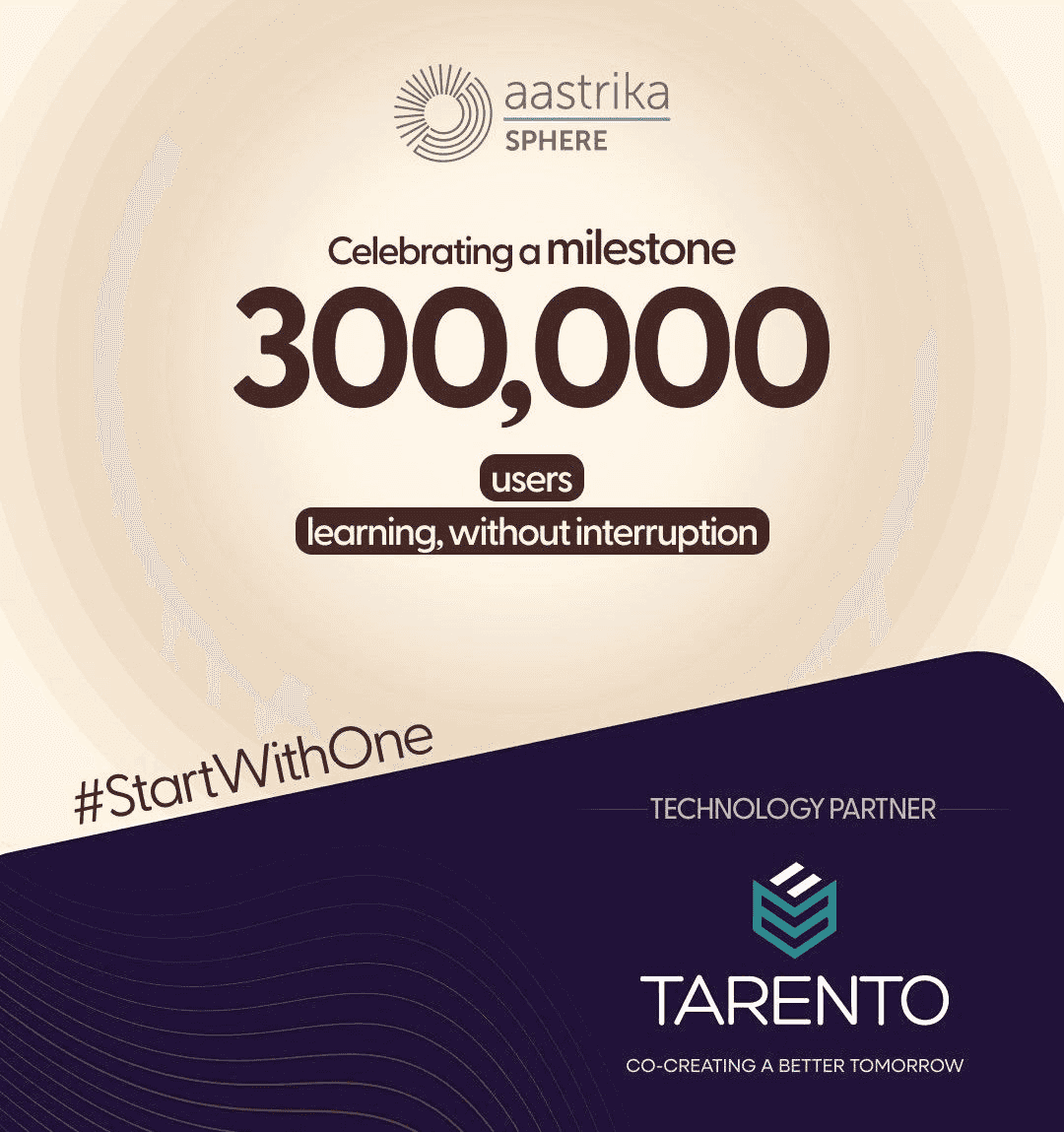
Aastrika Sphere has passed 300,000 learners, offering nurses, midwives and frontline health workers free, accredited training that runs without interruption.
Somewhere in India, between shifts, a nurse opens a phone and taps into a course on respectful maternity care. She is not paying for it. She is not travelling to a city to attend it. She earns Continuing Nursing Education points that count towards her career, in Hindi or in English, on a platform that loads when she needs it. She is one of 300,000.
Aastrika Sphere, the digital learning platform of the non-profit Aastrika Foundation, has crossed 300,000 learners. For a free, open-source platform built to lift the quality of maternal care across one of the world's largest health systems, the number is both a milestone and a measure of demand that has not stopped climbing.
Why a free learning platform matters in healthcare
India's maternal healthcare workforce is enormous, widely spread, and historically underserved by formal continuing education. Doctors, nurses, midwives and ASHA (Accredited Social Health Activist) workers staff thousands of facilities, yet the training open to them has tended to be fragmented, paid for, or simply out of reach for the people on the front line.
Aastrika Foundation, founded in 2019 by Dr Janhavi Nilekani and supported by Nilekani Philanthropies, set out to close that gap. Its premise is direct: better-equipped health workers mean safer births. Aastrika Sphere is the engine for that, a collaborative platform built for health-system strengthening and capacity building at scale, hosting more than 500 free courses accredited by the Indian Nursing Council and contributed by over 20 partner organisations.
The technology story behind the number
A platform that has to be free, open to many partners, and ready for national reach cannot start from a closed, licensed system. Aastrika Sphere is built on Sunbird, the open-source learning and digital public goods stack incubated by EkStep Foundation and used by several national-scale programmes in India. Tarento took that foundation and shaped it into a working platform, then kept it running and growing as the audience multiplied.
A Sunbird implementation customised for an evolving maternal health curriculum, healthcare-specific features such as validated certificate credentialing and a custom authentication mechanism, and a Fusion UI front end joined to a headless Sunbird back end. It was run as a continuous delivery loop, so feedback from partners and the field moved into the platform without long release cycles.
The growth itself tells the story. The platform served roughly 8,000 health workers in its first phase. By Aastrika Foundation's five-year mark in 2024 it had passed 100,000 learners, with around 200 courses and 11,000 learning hours delivered. Today it stands at 300,000. Each step up was carried by the same open-source foundation, reshaped rather than rebuilt.
Building for scale, without interruption
Reaching that many people is one thing. Holding the experience steady for each of them is another, and it is the part that does not show up in a screenshot.
"Building for scale is never just about infrastructure," Tarento said of the milestone. "It is about making sure that every single one of those 300,000 users gets a seamless, uninterrupted experience, every login, every session, every lesson. That is the standard we hold ourselves to." For a learner who is a nurse fitting a lesson between rounds, that standard is the difference between a tool she returns to and one she abandons.
A platform inside a larger mission
Aastrika Sphere is one part of a broader programme. Aastrika Foundation also supports the Government of India's Nurse Practitioner in Midwifery programme in Karnataka, working with the state's Department of Health and Family Welfare and UNICEF, which has led to a National Midwifery Training Institute at Vanivilas Hospital in Bengaluru. Its Aastrika Midwifery Centre serves as a clinical centre of excellence. Across the digital platform, content partners include UNFPA, the Maternity Foundation, the Fernandez Foundation and the White Ribbon Alliance, alongside collaborations such as the Manyata work with FOGSI on clinical standards and a competency-based rollout in Uttar Pradesh through the E-Kshamata app.
Aastrika Foundation has set a goal to support access to high-quality maternity care for 25 million women a year by 2030. Dr Nilekani has framed the mission around a simple belief, that every woman deserves "respectful, timely, and high-quality maternity care." A platform that puts free, accredited training within reach of 300,000 health workers is one of the routes there.
What 300,000 signals next
Milestones like this are easy to read as endpoints. This one is better read as a marker on a curve that is still rising. The platform has tripled its learner base since its five-year mark, its course catalogue has grown past 500, and the goal it serves is measured in millions of mothers.
As Aastrika Sphere marks the milestone, Tarento marks it with them. Congratulations to the entire Aastrika team on reaching 300,000 learners.
See how we engineered this platform at scale: read the case study

Tarento x Xylem: Driving Innovation in Water Technology