



From rigid rule-based systems to autonomous intelligent agents

Traditional Automation
Executes predefined rules. If-this-then-that logic for structured, repetitive tasks.
Fails with ambiguity, context interpretation, or multi-step decision-making.

Generative AI
Brings context awareness and problem-solving. Generates content, automates documentation, personalizes experiences.
Adaptive automation with LLMs powering intelligent workflows and hyper-personalization.

Agentic AI
Autonomous agents that understand goals, plan approaches, adapt strategies, execute workflows independently.
From task execution to autonomous orchestration with cognitive reasoning and memory.
Systems face relentless demands—millions of transactions, real-time processing, zero-tolerance downtime:

Ambiguity & Context
Tasks requiring understanding of nuanced language, implicit requirements, or contextual clues

Multi-Step Decisions
Workflows requiring planning, prioritization, adaptation, dynamic replanning based on outcomes

Dynamic Adaptation
Processes needing real-time adjustment based on changing conditions and feedback loops

Knowledge Work
Cognitive tasks requiring human expertise, judgment, and domain knowledge

 Customer service: Handle routine inquiries, escalate complex issuesRPA + Cognitive: Execute data entry, analyze unstructured documentsSales agents: Qualify leads, personalize outreach, recommend productsCode agents: Review pull requests, identify bugs, suggest improvements
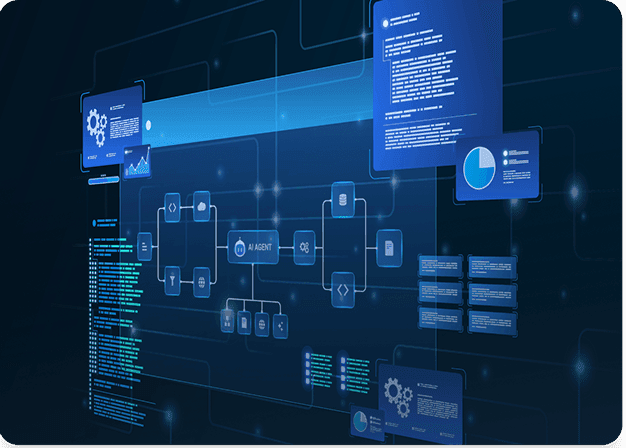
Autonomous AI Agents
How Agents Work
- Perceive: Ingest signals from data feeds, APIs, and system integrations
- Reason: Compare current state vs. desired outcomes and identify gaps
- Plan: Break work into steps and choose the best approach
- Act: Execute workflows with autonomous decisioning
- Learn: Improve over time using memory and feedback
- Coordinate: Orchestrate multiple agents to achieve complex goals
Agents don’t just automate tasks—they plan, adapt, and run end-to-end workflows.

Cognitive Process Automation
Automating knowledge work requiring contextual understanding, judgment, and expertise
- Claims Processing: Review documents to assess coverage eligibility
- RFP Automation: Parse requirements and draft responses faster
- Code Review & Security: Flag bugs, vulnerabilities, and style issues in PRs
- Legal Analysis: Extract clauses, compare versions, surface risks for review
- Financial Reconciliation: Match transactions, detect discrepancies, suggest fixes
 Evaluate current context (market, system states, behaviors)Select optimal actions from available optionsWeigh trade-offs (business rules, compliance, risk)Execute decisions aligned with objectivesCapture outcomes through feedback loopsInform future decisions creating improvement cycles
Adaptive Automation & Real-Time Decisions
Systems that adjust to changing conditions—not static workflows.
- Inventory: Track stock, suppliers, and demand; auto-reorder on thresholds
- Dynamic Pricing: React to competitors, demand, and inventory to maximize margin
- Customer Routing: Use sentiment and history to route high-value customers to premium support

Hyper-Personalization at Scale
GenAI enables individualized experiences impossible through manual customization
- Marketing: Personalized emails and content by behavior and demographics
- E-commerce: Dynamic product copy optimized for intent and preferences
- Education: Adaptive learning paths by pace, difficulty, and performance
- Recommendations: Context-aware suggestions using preference signals
- Conversational AI: Assistants that keep context across sessions
- Customer Experience: Move from generic journeys to 1:1 relevance

Design, Prototyping & Content Generation
Create faster. Iterate smarter. Ship sooner.
- UI/UX: Mockups, components, layout suggestions
- Backend: APIs, schemas, architecture drafts
- Resourcing: Staffing, budget, timeline optimization
- Docs: API refs, guides, diagrams from code
- Compliance: Audit-ready reports and policy drafts
- Meetings: Transcripts, decisions, action items, summaries
Responsible AI Architecture
Ethical, compliant, transparent autonomy—by design.
- Human-in-the-Loop: Human approval for high-stakes actions
- Model Audits: Data checks, bias detection, performance monitoring
- Explainability: Clear rationale for every decision
- Security Controls: Authorized access only
- Confidence Gates: Escalate when certainty drops
- Versioning: Track changes, enable rollback
DataVolve: AI-Driven Data Migration Intelligence
ML-Powered Migration Capabilities:
 Automated Profiling : Examine legacy platforms extracting metadata, pipeline complexity, dependencies
 AI-Assisted Migration : Translate between SQL dialects, orchestration models, cloud platforms intelligently
 Anomaly Detection : Identify data quality issues, schema inconsistencies, performance bottlenecks
 Predictive Planning : Forecast resource requirements, migration timelines, system behavior
 Self-Healing Pipelines : Detect errors, apply corrections, retry failures automaticallyCost Optimization : Recommend infrastructure configurations balancing performance and expense
Ready to Build Autonomous AI Agents?
Transform operations with Tarento's Generative and Agentic AI services. Explore intelligent automation opportunities and autonomous agent development.