

October 6th, 2026
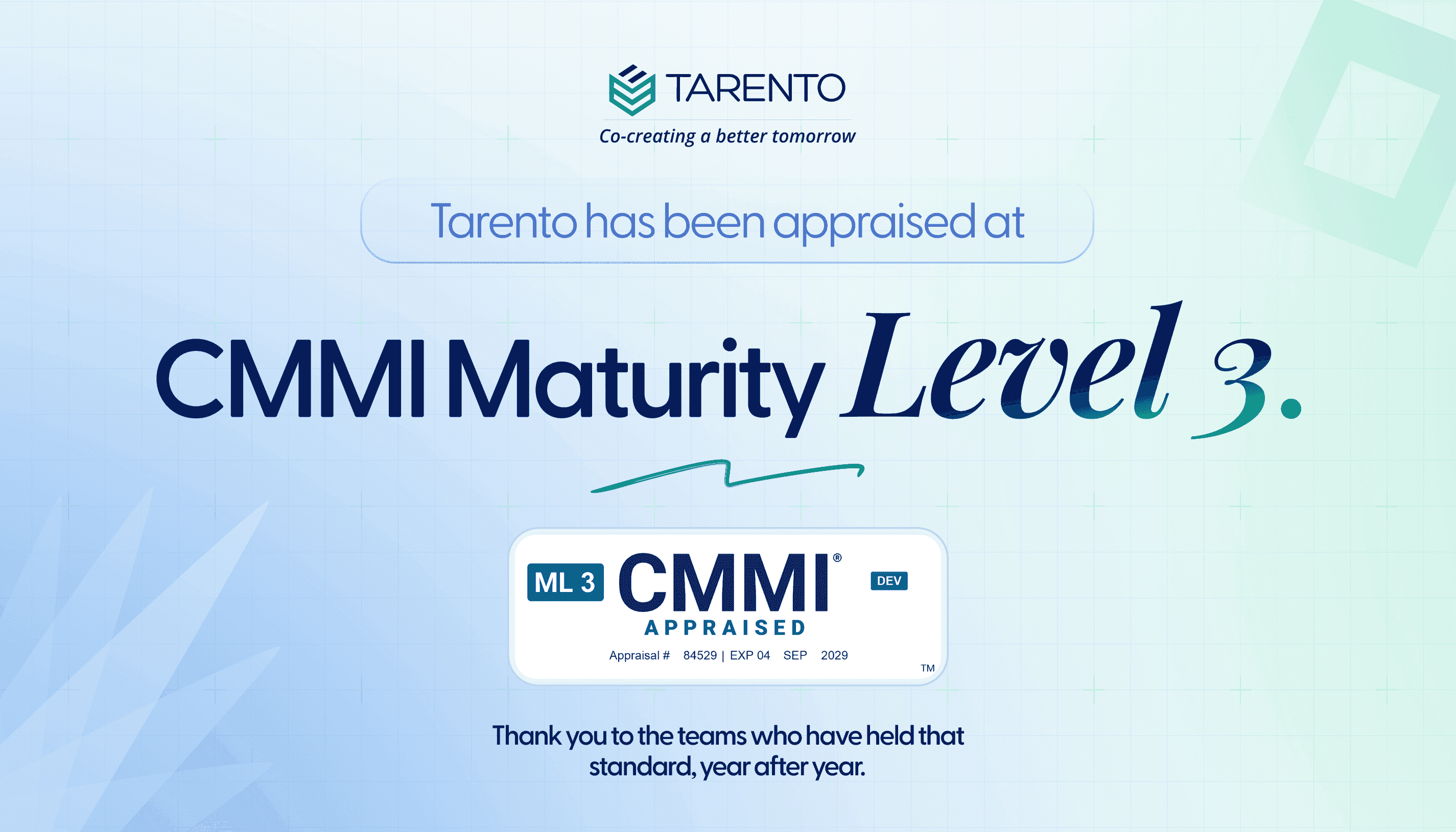
Tarento Technologies has been appraised at Maturity Level 3 of Capability Maturity Model Integration (CMMI) Development for its Software Development Department.
The result is published in the CMMI Institute's Published Appraisal Results System (PARS) under appraisal ID 84529. It is valid from Sept. 4, 2026, through Sept. 4, 2029. For enterprise clients, the appraisal provides independent evidence that the appraised department follows defined and consistently applied software development processes.
What Does Tarento's CMMI Level 3 Appraisal Cover?
The appraisal covers one organizational unit: Tarento's Software Development Department. It rates that unit at CMMI Development Maturity Level 3.
| Detail | Value |
|---|---|
| Model | CMMI Development |
| Maturity level | Level 3 (Defined) |
| Organizational unit | Software Development Department |
| Appraisal ID | 84529 |
| Valid from | Sept. 4, 2026 |
| Valid until | Sept. 4, 2029 |
| Registry | CMMI Institute Published Appraisal Results System (PARS) |
What Is CMMI Development Maturity Level 3?
CMMI Development Maturity Level 3 means that an organization's development processes are defined as standards and applied across its projects. The CMMI Institute describes Level 3 as "proactive, rather than reactive," with "organization-wide standards" that "provide guidance across projects, programs, and portfolios."
CMMI Development is a set of best practices for building products and software. The CMMI Institute describes it as improving "an organization's capability to develop quality products and services that meet the needs of customers and end users."
An appraisal compares an organization's actual working practices against these best practices. The result is a maturity level.
The six CMMI maturity levels
| Level | Name | CMMI Institute description |
|---|---|---|
| 0 | Incomplete | "Ad hoc and unknown. Work may or may not get completed." |
| 1 | Initial | "Unpredictable and reactive. Work gets completed but is often delayed and over budget." |
| 2 | Managed | "Managed on the project level. Projects are planned, performed, measured, and controlled." |
| 3 | Defined | "Proactive, rather than reactive. Organization-wide standards provide guidance across projects, programs, and portfolios." |
| 4 | Quantitatively Managed | "Measured and controlled. Organization is data-driven with quantitative performance improvement objectives…" |
| 5 | Optimizing | "Stable and flexible. Organization is focused on continuous improvement…" |
Why Process Maturity Matters When You Choose a Software Partner
Process maturity matters because a client can't see how a software partner works day to day before signing a contract. An independent appraisal published in a public registry gives that client evidence they can check.
Problem: Most software vendors describe their delivery process in their own words. A buyer can't easily tell whether a process is defined and applied consistently, or only written in a proposal. Some vendors also claim a CMMI level that no appraisal supports. The CMMI Institute calls these "false certification" claims and publishes guidance on how to spot them.
Solution: A CMMI appraisal is done by an appraiser authorized by the CMMI Institute, not by the vendor itself. When the organization authorizes publication, the result appears in PARS with an appraisal ID, a scope and validity dates. A buyer can check every part of the claim.
To verify Tarento's CMMI Level 3 appraisal on PARS →
What CMMI Level 3 Means for Tarento's Clients
For clients, the appraisal is independent evidence that Tarento's Software Development Department works to defined, documented practices that every project applies. These practices are intended to support:
| Area | What Level 3 process maturity supports |
|---|---|
| Delivery | Defined planning, estimation and tracking practices based on organizational standards |
| Quality | Standardized review and quality-management practices |
| Governance | Defined roles, processes and decision mechanisms |
| Continuity | Less dependence on individual working styles or undocumented practices |
| Improvement | A consistent process base that can be measured and improved over time |
Our Vision: Tarento's longer-term aim is CMMI Maturity Level 5, "Optimizing," which the CMMI Institute describes as "stable and flexible," with an organization "focused on continuous improvement" that is "built to pivot and respond to opportunity and change." The route to Level 5 runs through Level 4 practices, where delivery is measured and managed against quantitative objectives. The defined processes now in place in the Software Development Department are the starting point for that work.
Tarento is also looking ahead to CMMI AI Maturity (CMMI AIM), the model the CMMI Institute launched in July 2026 to govern how organizations build and use AI. CMMI AIM covers 31 practice areas across eight domains, with AI-specific additions in nearly half of its practices.
"Getting to CMMI Level 3 meant agreeing on one way of planning, reviewing and tracking our software work, and then making sure every team actually used it, not just the teams that already worked that way," said Vijay Sunkeswari, Managing Director at Tarento. "With that foundation in place, our next focus is bringing the same discipline to how we build and use AI, because AI is now part of more and more of the work we deliver for clients."
About Tarento
Founded in 2009, Tarento is a Nordic-Indian technology partner with offices in Stockholm, Helsinki, Bergen, Bengaluru, Indore and Colorado. Tarento works with enterprises on AI, data, application modernization, cloud and DevOps, ERP and managed services, and it builds its own solutions for enterprise transformation.
The appraised department's defined practices apply to the software we build across Tarento's services. Learn more at tarento.com.

Tarento x Xylem: Driving Innovation in Water Technology