
#AheadoftheCurve: Connected Vehicle Platform for Automotive Leaders

Predictive Maintenance, Telemetry, and OTA on One System
The global connected car market is on track to roughly quadruple by the early 2030s, and OTA updates already account for the single largest share of that spend.
Vehicles have stopped being mechanical products with software attached. They're now data platforms that happen to have wheels — generating telemetry, running predictive models, and receiving updates without a single dealership visit. For automotive manufacturers, OEMs, and fleet operators, the strategic question isn't whether to connect the vehicle. It's whether the platform underneath can turn that connection into fewer breakdowns, faster updates, and a genuinely lower cost base — before a competitor gets there first.
Why the connected vehicle race has changed shape
The connected car market is projected to grow from roughly $145 billion in 2026 to over $568 billion by 2034, an 18.6% compound annual growth rate, and OTA update capability alone holds the largest single share of that market. That growth isn't just feature adoption — it's cost avoidance at scale. Automotive recalls typically cost between $300 and $2,000 per affected vehicle depending on whether the fix is software or hardware, and campaigns affecting large fleets can run into the tens of millions. OTA-capable platforms let manufacturers resolve a growing share of those issues remotely, without a single service bay visit.
That's the commercial logic. The operational reality for most automotive leaders is messier: cost pressure limits how fast innovation can scale, legacy systems resist integration with modern cloud tooling, and finding a technology partner with both the engineering depth and the industry-specific expertise to close that gap is genuinely hard. Meanwhile customer expectations for smarter, faster, more personalised vehicle experiences keep rising, and regulatory requirements around safety, cybersecurity (UNECE WP.29, ISO/SAE 21434), and sustainability keep tightening. Standing still isn't a neutral option in this market — it's a slow way of falling behind.
What a connected vehicle platform actually needs to do
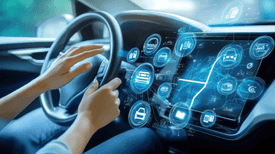
A connected vehicle platform earns its place in this environment by doing four things well: catching problems before they become failures, giving fleet and engineering teams a real-time view of vehicle performance, feeding AI systems the clean data they need to actually work, and pushing improvements to vehicles already in the field. Tarento's Connected Vehicle Platform (CVP) is built around exactly that shape — a modular system that brings IoT, AI, and cloud technologies together, designed so mobility enterprises can modernise around their existing infrastructure rather than ripping it out.
Predictive maintenance that earns its keep
CVP uses real-time sensor data and machine learning models to flag anomalies before they escalate into failures, enabling planned maintenance windows rather than reactive repairs. Independent industry studies on connected-vehicle predictive maintenance programmes have reported downtime reductions in the range of 30–40% when manufacturers move from fixed-schedule or reactive servicing to sensor-driven prediction — the kind of margin that changes fleet economics rather than just tidying up a maintenance log.
Real-time telemetry, properly used
Telemetry tracking on engine performance, fuel consumption, and driver behaviour only pays off if it feeds decisions, not just dashboards. CVP's telemetry layer is built to support route optimisation, fuel cost reduction, and performance benchmarking across a fleet, so the data collected translates into operational choices rather than sitting unused in a report nobody opens.
AI-driven insight, correctly scoped
CVP applies AI to surface patterns in vehicle and driver data that inform smarter fleet and product decisions. Worth being precise about what this does and doesn't mean: real-time safety functions like adaptive cruise control and collision detection run on the vehicle's own onboard systems, where the latency requirements are measured in milliseconds. What CVP contributes is the data pipeline and model training loop that ADAS features are validated and improved against over time — the platform strengthens the safety system; it doesn't replace the onboard control layer.
Architecture that respects what's already there
Built on a modular architecture, CVP integrates with existing systems — including legacy ones — rather than demanding a rebuild before value can be delivered. Organisations can modernise incrementally, adding capability as budget and confidence allow, which matters enormously for manufacturers running infrastructure that predates the cloud-native era.
Companion apps and OTA, where the customer sees it
Companion applications deliver live tracking, geo-fencing, remote controls, and maintenance alerts directly to the end user, which is where connected features actually build loyalty rather than just technical capability. OTA update delivery sits alongside this, letting manufacturers push new features and security patches directly to vehicles in the field — a capability that's shifted, across the industry, from a premium differentiator to a baseline operational requirement in the space of a few years.
What changes with a foundation-first connected vehicle platform
| Fragmented, bolt-on approach | Unified platform approach (CVP) | |
|---|---|---|
| Maintenance model | Reactive or fixed-schedule servicing | Predictive, triggered by real anomaly detection |
| Telemetry | Siloed per system, rarely acted on | Centralised and tied to route, fuel, and performance decisions |
| Software updates | Physical recalls and dealership visits | OTA delivery, remotely and at fleet scale |
| Legacy systems | Blocker to modernisation | Integrated incrementally via modular architecture |
| ADAS data support | Ad hoc, disconnected from the platform | Structured pipeline feeding model validation and improvement |
| Customer-facing experience | Limited to in-vehicle features | Extended via companion apps: tracking, geo-fencing, alerts |
Turning the constraints into an advantage
The same pressures that make connected mobility hard — cost, legacy complexity, compliance, security — are exactly what a properly built platform is designed to absorb. CVP is built to reduce operating costs through efficiency gains, preserve compatibility with legacy estate rather than forcing a rebuild, scale as fleet or product lines grow, hold up against tightening regulatory requirements, and maintain security through encryption and continuous monitoring. None of that is about chasing the newest feature. It's about making sure the platform doesn't become the next legacy problem five years from now.
Being ahead is an engineering decision, not a slogan
Staying ahead in connected mobility means predicting issues before they surface, shipping updates proactively rather than reactively, and building experiences that meet rising customer expectations without a corresponding rise in operational risk. That's a platform decision as much as a strategic one. The connected car shift is already well underway — the manufacturers who get ahead of it aren't the ones with the flashiest feature list, but the ones whose foundation was built to support what comes next.
Frequently asked questions
1. What is a connected vehicle platform (CVP)? A connected vehicle platform integrates IoT sensor data, AI models, and cloud infrastructure into one system, enabling predictive maintenance, real-time telemetry, over-the-air (OTA) software updates, and connected companion app experiences across a manufacturer's or fleet operator's vehicle base.
2. How much can predictive maintenance reduce vehicle downtime? Industry studies on connected-vehicle predictive maintenance programmes report downtime reductions typically in the 30–40% range when manufacturers move from reactive or fixed-schedule servicing to sensor-driven, AI-flagged maintenance, though actual results vary by fleet composition and data quality.
3. Does a connected vehicle platform control safety features like adaptive cruise control? No. Real-time safety functions such as adaptive cruise control and collision detection run on the vehicle's onboard ECU and ADAS systems, which operate under strict, low-latency constraints. A connected vehicle platform supports these systems by supplying the data pipeline used to train, validate, and continuously improve them — it doesn't perform real-time control itself.
4. Why are OTA updates increasingly important for automotive manufacturers? Automotive recalls typically cost between $300 and $2,000 per affected vehicle, and can scale into the tens of millions across large campaigns. OTA updates let manufacturers resolve a growing share of software-related issues remotely, cutting recall costs and reducing the operational disruption of dealership-based fixes.
5. Can a connected vehicle platform work with legacy automotive systems? Yes, provided it's built on a modular architecture designed for incremental integration. Tarento's CVP is built specifically to connect with existing infrastructure, including legacy systems, so manufacturers can modernise in stages rather than needing a full platform rebuild before seeing value.
Ready to build a platform that thinks ahead?
If your connected vehicle strategy is still stitched together from point solutions, that's the gap CVP is built to close. Get in touch to talk through what a unified platform would look like for your fleet or product line.

#AheadoftheCurve: Why OTA Updates Are the New Competitive Advantage