
Distributed Systems Reliability: 5 Principles That Separate Resilient Architectures From Fragile Ones
A practical engineering guide to building fault-tolerant distributed systems that survive failure, network partitions, retries, and overload.
Distributed systems do not fail the way single-process applications do. They fail quietly, partially, and in ways that look fine on dashboards while causing real damage underneath. Two nodes disagree. A queue drowns silently. A payment fires twice. Alerts stay green.
The difference between systems that degrade gracefully and systems that collapse is rarely the technology stack. It is whether the engineers understood a handful of foundational principles — and designed for failure before it arrived.
Executive Summary: Core Distributed Systems Principles for Reliable Architecture
- Consensus and Quorums — Agreement between nodes is not automatic. Quorums define the minimum agreement required for a decision to be safe.
- Why Distributed Systems Fail Surprisingly — Failures are partial, emergent, and often invisible. Designing for failure is not optional — it is the baseline.
- Network Partitions and Trade-offs — Partitions are guaranteed. CAP and PACELC tell you what to decide before they happen.
- Exactly-Once vs. At-Least-Once Semantics — Delivery may repeat. Business impact must not. Idempotency bridges the gap.
- Back-pressure — Fast producers overwhelm slow consumers. Systems that cannot say "slow down" eventually say "system down."
1. Consensus and Quorums: The Mathematics of Agreement
Distributed systems fail not because nodes crash — but because nodes disagree. Two leaders believe they are in charge. Two regions accept conflicting writes. Two truths exist simultaneously. Consensus prevents this. Quorums are the mathematics that make consensus safe.
A quorum is the minimum number of nodes required to agree before a decision is final. In a system with N replicas, a majority quorum is ⌊N/2⌋ + 1. The invariant: any two quorums must overlap — preventing two conflicting decisions from both achieving majority support.
The practical rules:
- Write quorum: enough replicas must confirm before a write is acknowledged
- Read quorum: enough replicas must be consulted before a read is trusted
- The safety rule:
read_quorum + write_quorum > N - Raft and Paxos use quorums to guarantee correctness even when progress temporarily stalls
When teams skipped it: A team running three replicas allowed single-node writes for availability. Reads were load-balanced randomly. During a partition, two regions accepted conflicting updates to the same order. When connectivity restored, there was no authoritative version — only corruption disguised as success. The root cause was not the database. It was the absence of a quorum rule.

2. Partial Failure in Distributed Systems: Why Failure Is the Default, Not the Exception
Crossing a network boundary removes the guarantees you had inside a single process. Operations are no longer atomic, ordered, or immediate. Messages can be delayed, duplicated, or dropped. A timeout does not mean failure — it means you do not know what happened.
The result is failure modes that are partial, emergent, and invisible until real load or real latency arrives.
Common failure patterns teams miss:
- Timeout ambiguity — The operation may have succeeded, failed, or partially completed. Blind retries cause duplicates
- Emergent feedback loops — Retries increase load, load increases latency, latency triggers more retries. Each service is individually healthy; the system is collapsing
- Partial failure — One component degrades; others keep pushing work at full speed
When teams didn't follow this: An order processing system had retries at both the payment and inventory services. A brief database slowdown caused timeouts — but many operations were succeeding late. Retries produced duplicate reservations and double payments. Every service showed green. Reconciling the state took days.
Distributed systems do not reward optimism. They reward explicit failure design.
3. Network Partitions, CAP, and PACELC: Choosing the Right Trade-off Before Failure
A network partition is when nodes stop communicating — not because they failed, but because the network between them did. No code crashed. The system simply split, with each side continuing to operate independently.
The CAP theorem states that during a partition, a system must choose between Consistency (every node returns the same data) and Availability (every request gets a response). PACELC extends this: even without a partition, there is a trade-off between Latency and Consistency.
| Choice | Behaviour during partition | Suits |
|---|---|---|
| CP | Refuses to respond until nodes agree. Requests may stall. | Financial transactions, leader election, config management |
| AP | Keeps responding with potentially stale data. Reconciles after. | Product search, activity feeds, session data |
When teams didn't follow this: A fintech wallet service ran on an AP database without designing the debit flow for eventual consistency. During a partition, both availability zones accepted debits independently. When the partition healed, hundreds of accounts were double-debited. The system never went down — it was silently wrong for twenty minutes and took three weeks to remediate.
Availability without consistency guarantees is not resilience. It is a deferred incident.
4. Exactly-Once vs. At-Least-Once Delivery: Preventing Duplicate Business Impact
In a distributed system, retries are not exceptional — they are guaranteed. Consumers crash before acknowledging. Networks drop acknowledgements. Brokers redeliver. The question is not whether delivery will repeat. It is whether your application is designed for it.
At-least-once guarantees delivery but allows duplication. Exactly-once guarantees that business impact happens once, even if delivery repeats. True end-to-end exactly-once is architecturally difficult because messaging, processing, and external calls exist in different failure domains. The practical model: make the consumer idempotent.
How to achieve it:
- Store a transaction or event ID before processing — reject redeliveries
- Use unique database constraints as a last-resort deduplication guard
- Commit state before triggering external side effects
- Use idempotency keys on every write to external APIs
When teams didn't follow this: An e-commerce team consumed PaymentCaptured events to generate invoices and trigger shipments. A deployment caused a consumer to crash before acknowledging. The broker redelivered. Without an idempotency check, the system generated two invoices and two shipment requests. The failure was not the retry — it was assuming retries would never produce duplicate business outcomes.
5. Back-pressure in Distributed Systems: How Reliable Architectures Handle Overload
Every system performs well under a predictable load. The failure occurs when one component becomes slower than everything upstream. A queue grows faster than workers can drain it. A database slows down, but the API keeps accepting requests at full rate. Without back-pressure, the slower component is not protected — it is overwhelmed.
Back-pressure is a system's ability to signal upstream components to slow down, pause, or shed load when downstream capacity is limited. It is not a performance feature. It is a reliability pattern.
Common Back-pressure Mechanisms for High-Scale Systems:
- Bounded queues — when full, producers must wait or fail fast
429 Too Many Requests— the correct response when capacity is reached- Circuit breakers — stop calls to a degraded downstream service
- Retry budgets — a maximum retry count and backoff ceiling; unbounded retries are load generators
- Consumer lag monitoring — treat growing lag as an early warning signal
What Happens When Teams Ignore Downstream Capacity Limits: A notification system consumed order events during a campaign spike. The SMS provider began throttling. Workers retried without a budget. The queue grew, database reads increased, and unrelated services sharing the same database slowed down. What started as delayed SMS became platform-wide degradation — preventable with a bounded queue and circuit breaker.
The Common Thread: Reliable Distributed Systems Are Designed for Failure
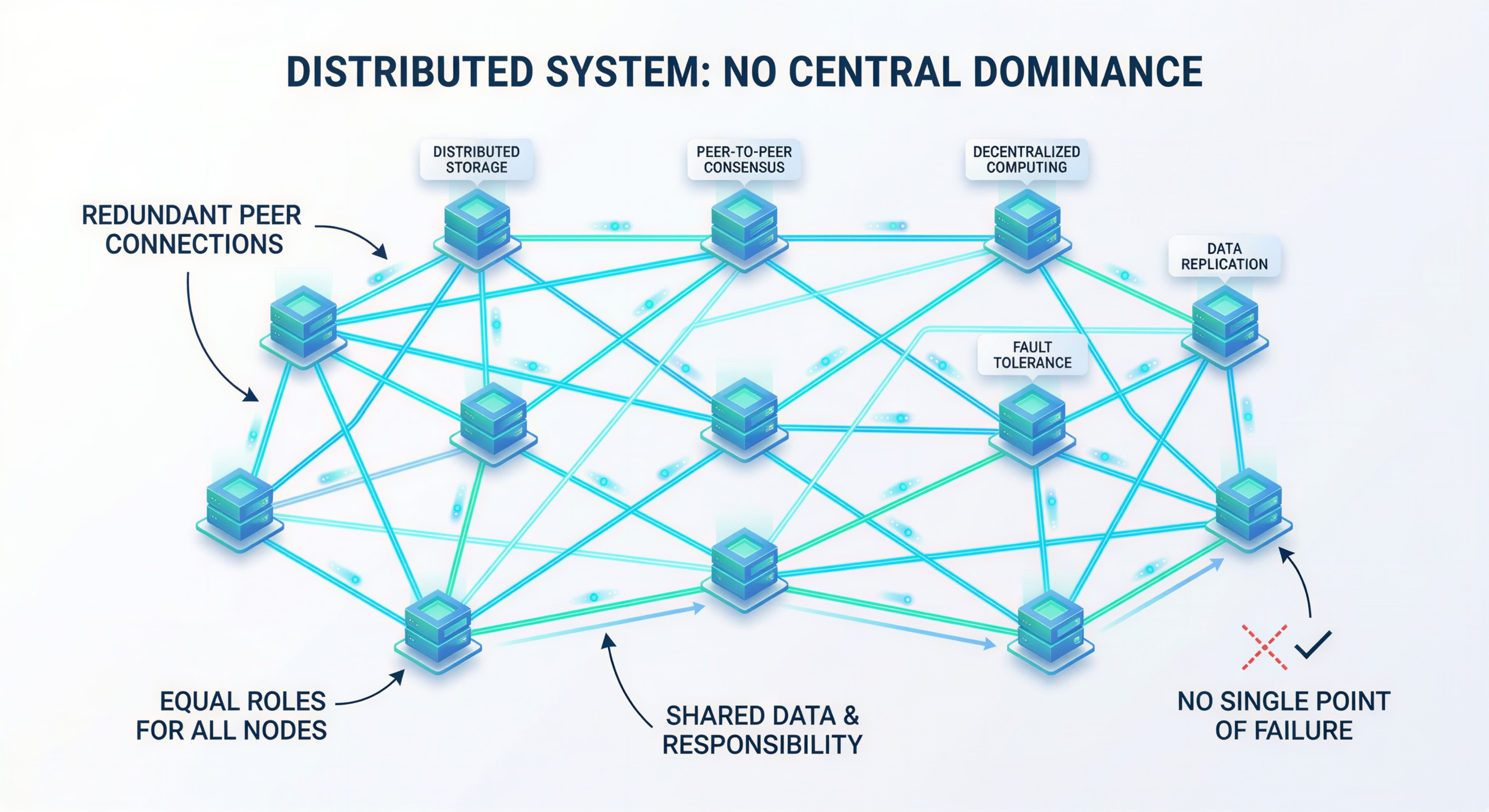
These five principles reinforce each other. Consensus defines correctness. Understanding failure modes tells you what to design against. Partition trade-offs determine what correctness means during splits. Delivery semantics protect business integrity when messages repeat. Back-pressure protects the system when any component slows.
The common thread is intentionality: knowing what your system does when things go wrong — before they do. Pick one principle. Trace it through one critical service this week.
Distributed Systems Reliability FAQ
1. What is a quorum and why does it matter? A quorum is the minimum number of nodes that must agree before a decision is safe. The rule that makes it work: any two quorums must overlap, preventing two conflicting decisions from both achieving majority support. Without quorum-based writes, partitioned systems can silently accept conflicting states.
2. What does the CAP theorem actually mean in practice? When a network partition occurs, you must choose either refuse requests until nodes agree (CP), or keep responding with potentially stale data (AP). You cannot guarantee both during a split. The choice is a product and business decision, not just a technical one — it defines what your system promises users when things go wrong.
3. What is the difference between exactly-once and at-least-once delivery? At-least-once guarantees delivery but allows duplication. Exactly-once guarantees that the business impact of an operation occurs only once, even if delivery repeats. In practice, exactly-once requires idempotent consumers — operations that produce the same result whether they run once or ten times.
4. What is back-pressure, and when does it matter? Back-pressure is a mechanism that lets a slow downstream component signal upstream components to reduce incoming work. It matters whenever one part of your system receives work faster than another can process it, which is most systems under real load. Without it, queues grow silently, retries amplify load, and a single slow component degrades the whole platform.
Learn more about Tarento´s Cloud & Enterprise Integration Services | iVolve: Integration Evolution for Enterprise Platforms


Enterprise UI Design Systems and Platform Updates: What Teams Need to Know Before the Next OS Release