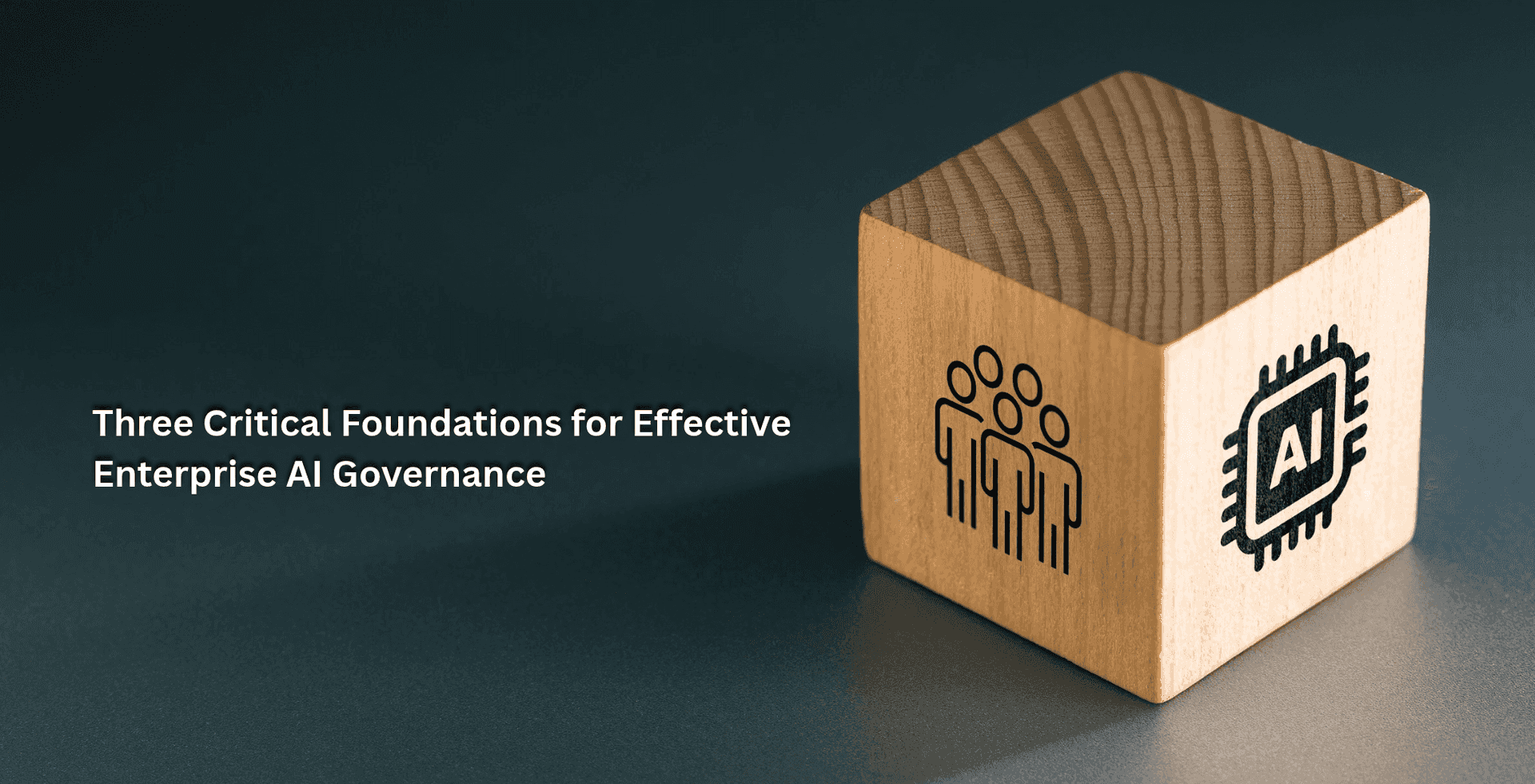
Three Critical Foundations for Effective Enterprise AI Governance
Research increasingly shows that a substantial share of employees are already using AI tools outside their organisation's approved technology stack, while breach reports continue to highlight the financial and security risks associated with unmanaged AI use. Many organisations are still developing the policies and controls needed to govern that adoption consistently.
The hardest AI governance decisions look more like a developer wiring an internal database to a public model over a weekend, an analyst pasting a client spreadsheet into a free chatbot because the approved tool is three approval steps away, or a team quietly running an agent workflow nobody in security has ever seen. Individually, each shortcut is defensible. Together, they define whether an organisation's AI adoption compounds into real capability or quietly accumulates the kind of exposure that surfaces at the worst possible moment.
That is why AI governance belongs on the same table as AI strategy. How employees access approved tools, how quality gets verified before an agent workflow goes live, and how risk gets matched to actual exposure: these three decisions compound. This guide sets out what mature organisations get right on each one, and what typically goes wrong when they don't.
3 Governance Foundations That Close the Shadow AI Gap
- A genuinely usable self-service platform removes the reason to go around IT in the first place, since the approved path only wins if it is actually the fastest one.
- Quality gates built into the workflow itself catch the silent failures that unreviewed AI systems accumulate, before they reach a customer or a board pack.
- Risk-tiered evaluation matches scrutiny to actual exposure, so low-risk experimentation is not throttled by the same process a high-risk system genuinely needs.
1. Building a Self-Service Platform People Actually Choose
Employees do not build unauthorised AI workflows because they disregard security. They build them because the approved path costs more time than the problem is worth, and generative AI has made the unapproved path dramatically faster than it used to be. A single employee can now connect internal information to an AI model and external services in hours, often without needing traditional development skills. The barrier to experimentation has fallen dramatically, while enterprise governance processes have not always evolved at the same pace.
Why This Matters for the Business
Enterprise surveys increasingly show that employees across large organisations are using AI tools that sit outside approved technology environments. Security leaders report similar concerns, with many organisations aware of or actively investigating unapproved AI use. The question is whether that usage runs through a governed environment or a personal account nobody can see. Security leaders increasingly report direct evidence of employees using AI tools outside approved environments. The behaviour is not confined to non-technical employees; even teams with strong technical capabilities can turn to unapproved tools when the approved route is too slow or restrictive.
Key question: If your best engineer needed an AI tool for a task right now, would the approved route actually be their first choice, or their last resort?
What a Genuinely Usable Platform Actually Gets Right
A self-service AI platform that works does a small number of things well, and removes every reason to look elsewhere.
-
Access without friction. The right models, the right internal connections, and the right guardrails are already provisioned. Requesting access does not require a multi-week approval chain for a routine, low-risk task.
-
Parity with what's outside. If the external, unapproved option feels more capable or more responsive than the internal one, adoption of the internal option will always lag, regardless of what the policy document says.
-
Visibility without surveillance theatre. Usage is logged and reviewable by security, but the experience for the employee stays close to using any other approved internal tool, not a monitored, bureaucratic exception process.
When the Approved Path Loses, Shadow AI Wins by Default
A team once needed a quick way to summarise customer support transcripts for a weekly review. The internal AI platform existed, but provisioning access required a ticket, a manager approval, and a security review that typically took two weeks. One analyst instead pasted transcripts into a free public chatbot, got a usable summary in minutes, and shared the approach informally with three colleagues by the following week. None of them saw this as a security decision. They saw it as the obvious way to get the job done. By the time security discovered the pattern, customer conversations containing personal data had been flowing through an unreviewed third-party tool for months. A platform with same-day access for low-risk tasks would have made the internal option the faster one, and the shadow workaround would never have had a reason to start.
Removing the incentive to go around IT only works if the approved path is genuinely competitive on speed, not merely available in principle.
How it works: Designing the self-service layer people will actually use, rather than the one that looks correct in a policy document.
2. Quality Gates That Catch Silent Failure Before Production Does
One of the most overlooked risks in an employee-built AI workflow is not simply what data it might expose, but whether anyone can detect when the workflow stops behaving correctly.
Why This Matters for the Business
An individual Report found shadow AI involvement added an average of $670,000 to breach costs, and was a contributing factor in one out of every five breaches the study examined. That figure captures the incidents that get noticed. The quieter cost sits in workflows that keep running, producing subtly wrong output, for weeks or months before anyone realises. Enterprise use of AI on corporate devices is increasing rapidly, giving organisations less time to close the gap between adoption and governance, which means the number of unreviewed workflows accumulating this kind of silent risk is growing considerably faster than any organisation's ability to review them manually.
Key question: If an AI-built workflow in your organisation started producing subtly wrong output tomorrow, what would actually catch it, and how long would that take?
What a Governed Workflow Actually Requires
A workflow built with proper quality gates carries three things an unreviewed one almost never does.
-
Version control on the logic. Prompts and configuration that function as business logic are tracked and reviewable, not living only in one person's chat history or a document nobody else has seen.
-
Logging of what actually happened. Every step a workflow takes is recorded, so a failure can be traced to its actual cause rather than reconstructed from memory after the fact.
-
Automated tests confirming continued correctness. A workflow that behaved correctly on the day it was built is tested against what upstream systems and models still look like today, not assumed to still be accurate indefinitely.
When an Untested Workflow Became a Quiet Six-Week Failure
A workflow built by a business analyst pulled data from two internal systems, summarised it through a public model, and routed the result into a weekly report used by regional leadership. It worked well for months. Then one of the source systems changed a field format during a routine update. It kept running, silently misreading the changed field, and produced a subtly incorrect number in every report for six weeks before someone in a review meeting noticed a figure that did not match a separate source. Nobody had built a test that would have caught the change, because nobody involved had built workflows with that discipline before. A basic automated check comparing the workflow's output against the source system on a schedule would have caught the drift on day one instead of week six.
This is precisely the class of failure formal engineering practice exists to prevent, and it is exactly the practice that gets skipped when one person builds a system alone, outside any formal review.
This is the discipline behind Tarento's Quality Assurance & Automation and AI-Driven Operations practices: building verification into how AI workflows get shipped, not adding it after the first quiet failure gets noticed.
3. Matching Scrutiny to Actual Risk
Treating every AI workflow with identical review, whether it summarises internal meeting notes or touches customer financial data, produces the worst of both outcomes. Low-risk experimentation slows to a crawl under review it does not need, while genuinely high-risk systems can pass through a process that was never calibrated to catch what actually matters for their specific exposure.
Why This Matters for the Business
Despite rapid adoption, many organisations are still developing the policies, controls, and governance structures needed to manage AI consistently. The gap is not simply a resourcing problem. It is often a consequence of applying traditional approval processes to technology that can now be adopted and configured in hours rather than weeks.
Key question: Does your current review process actually take less time for a low-risk internal tool than it does for a system touching regulated customer data, or does everything get the same checklist?
What Risk-Tiered Governance Actually Looks Like
Effective governance sorts workflows by actual exposure before deciding how much scrutiny each one needs.
-
Low-risk, fast-tracked. Internal tools with no access to customer data, financial systems, or regulated information move through a lightweight review, often close to automatic, because the exposure genuinely does not warrant more.
-
Elevated risk, proportionate review. Workflows touching internal business data but not customer-facing systems get a meaningful but bounded review, focused on the specific exposure that actually exists.
-
High risk, full scrutiny. Systems with access to customer financial data, regulated information, or autonomous action on production systems get the full review process, and that process should be visibly slower, because the stakes genuinely justify it.
When One-Size-Fits-All Review Missed the System That Actually Mattered
An organisation ran every AI-adjacent request through the same review queue, regardless of what the tool actually touched. A team building a low-risk internal glossary tool waited five weeks for approval alongside a genuinely high-risk workflow with direct access to customer payment data, because both entered the same queue at the same priority. The glossary tool's delay pushed frustrated team members toward unapproved alternatives. The payment-data workflow, meanwhile, received exactly the same five-week review as the glossary tool, not a longer, more rigorous one calibrated to what it could actually expose if something went wrong. Splitting the queue by actual risk after the fact cut the low-risk approval time to two days and let the review team spend meaningfully more time on the handful of workflows that genuinely needed it.
Governance that treats every request identically is not being cautious. It is failing to ask the one question that actually determines how much scrutiny is warranted.
How it works: Building a review process calibrated to real exposure, not a single checklist applied uniformly regardless of stakes.
How to Evaluate These Three Foundations as a Leadership Team
These three decisions are not isolated: they compound:
-
A self-service platform only closes the shadow AI gap if it is genuinely fast enough to compete with going around IT entirely. Quality gates only catch the failures they are meant to catch if they are built into the default path, not treated as a step people can skip under deadline pressure. And risk-tiered review only works if the platform and the quality gates feeding it can actually tell a low-risk workflow from a high-risk one before deciding how much scrutiny either deserves.
-
Treated individually, each is a policy decision made by whichever team got there first. Treated together, as a governance strategy reviewed at leadership level, they are what separates organisations whose AI adoption compounds into real capability from organisations quietly accumulating the kind of exposure that shows up in the next breach report.
-
In distributed workforces, the gap between "we have a policy" and "the policy is actually followed" is rarely visible until an incident forces it into view. By then, the cost of not designing for it is already spent.
Frequently Asked Questions About Shadow AI Governance
1. What is shadow AI? Shadow AI is the use of AI tools, models, or agent workflows inside an organisation without formal IT approval or oversight. It extends shadow IT, but carries higher risk, because AI tools actively process and can retain the data passed through them, not just store it.
2. Should companies ban employees from using unauthorised AI tools? An outright ban rarely reduces actual usage; it reduces visibility into it, since the workaround simply moves to a personal device or account outside any monitoring. Treating repeated workaround behaviour as a signal about where the approved toolset falls short is more effective than relying on policy language alone.
3. How quickly should a low-risk AI tool request be approved? Fast enough that going around IT is not the faster option. Organisations that tier review by actual risk typically approve low-exposure internal tools within days, reserving longer, more thorough review specifically for workflows touching regulated or customer-facing data.
4. Who should own AI governance inside an organisation? Effective governance is shared, not siloed: security defines the risk tiers and review requirements, platform or engineering teams build the self-service environment and quality gates, and business unit leaders are accountable for surfacing workflows their teams are already running informally.
5. How can companies make AI governance faster without compromising security? By treating governance as infrastructure the platform ships with, rather than a checkpoint every new tool individually passes through. A pre-approved, hardened self-service environment lets most requests skip case-by-case review entirely, reserving the slowest, most thorough scrutiny specifically for genuinely high-risk use cases.
Ready to close the gap between AI adoption and AI governance?
Whether it's a self-service platform that isn't actually faster than going around IT, AI workflows shipped without the quality gates that would catch a silent failure, or a review process that treats every request identically regardless of risk: these are exactly the foundations Tarento's Generative & Agentic AI and Cloud & DevOps practices are built to strengthen.


AI LMS vs Traditional LMS: What Changes at Each Layer